Industrial & manufacturing cleaning in
Fort Payne, Alabama.
Shift-friendly cleaning for DeKalb County manufacturers, warehouses and distribution facilities: plant offices, high-use restrooms, break and locker areas, entrances, walkways and machine floor care.
Cleaning that keeps
a plant running.
Fort Payne is one of Northeast Alabama's most concentrated manufacturing markets. DeKalb County economic-development data lists the area's largest employers across truck-body manufacturing, distribution, park and playground equipment, metal fabrication, steel joists, automotive plastics, wire harnesses and energy components — Heil Environmental, The Children's Place distribution center, PlayCore, GH Metal Solutions, Nucor-Vulcraft, Plasman, Heritage Wire Harness and Siemens Energy among them.
Facilities like that do not need an office-cleaning pitch. They need a contractor who asks the operational questions first: when do shifts change, which walkways have to stay open, what PPE and site rules apply, how many people per shift use which restrooms, what the floor surface actually is, and which rooms are restricted.
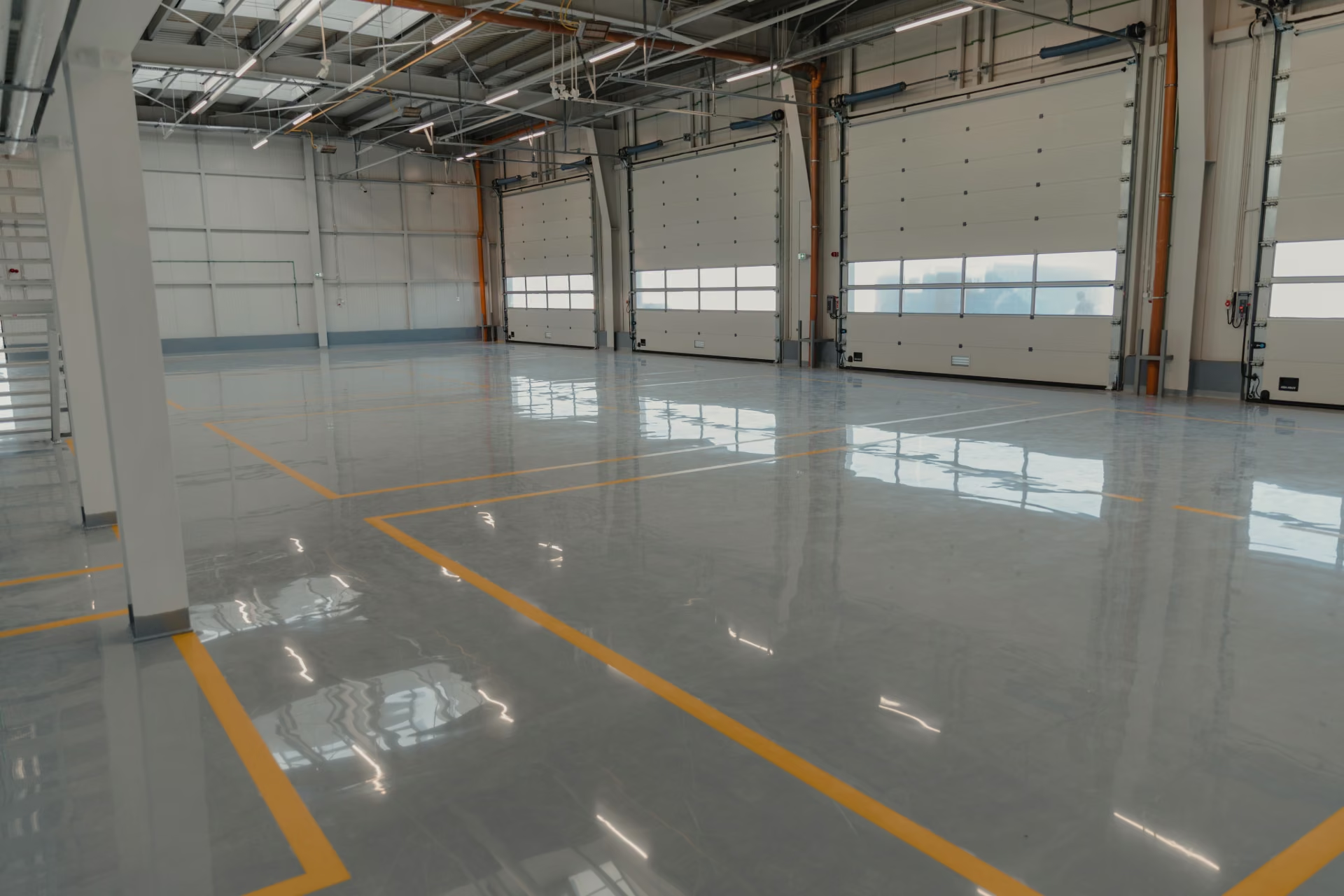
Our scope is the facility and the spaces that support production. Plant offices and conference rooms held to an office standard for employees, vendors and audits. Restrooms and break rooms cleaned at a frequency matched to shift headcount rather than square footage. Entrances and pedestrian walkways where soil control does the most good. Warehouse and support floors machine-scrubbed when the area can be isolated safely.
Our nearest office is in Gadsden — there is no Fort Payne branch, and we would rather be plain about that than imply one. What Fort Payne gets is a written scope, a consistent crew and a schedule set by your production calendar. See our regional manufacturing and warehouse cleaning or our wider Fort Payne commercial cleaning.
Get in touch.
Gadsden, AL 35903
 Active member, Fort Payne Chamber of Commerce
What an industrial clean covers here.
Plant offices and conference rooms
The administrative side of the plant held to an office standard: desks and common surfaces, glass, restrooms, break areas, trash and floors. These are the rooms customers, auditors and prospective hires actually see.
High-use restrooms
Fixtures, partitions, dispensers and touch points cleaned and disinfected at a frequency set by shift headcount, with optional par-level restocking of paper, soap, sanitizer and liners so a second-shift dispenser is not found empty.
Break rooms and locker areas
Tables, counters, sinks, appliance exteriors, vending fronts and floors, serviced around shift changes so the room is usable when the next crew takes lunch rather than mid-clean.
Warehouse and support floors
Machine scrubbing for concrete, sealed and resilient floors where debris type and traffic allow, plus VCT stripping and refinishing in offices and corridors. We identify the floor system before selecting a pad, chemical or process.
Periodic and project work
Carpet extraction in offices, deep detail cleaning during shutdowns, post-construction turnover and dumpster-pad or exterior work that falls outside a standard janitorial scope. Planned around downtime, not squeezed into it.
Industrial areas we serve around Fort Payne
Why DeKalb County plants choose Sweepers.
Scheduled around production
Shift changes, maintenance windows and downtime set the cleaning schedule. Your team should not be working around cleaners.
Commercial floor equipment
Larger facilities need more than a mop and bucket. Machine scrubbing and refinishing are matched to the actual floor system.
Safety and access documented first
Restricted areas, PPE, traffic routes and site rules are recorded before the first visit and briefed to the assigned crew.
Clear scope boundaries
Production-support cleaning is defined in writing, and so is what we do not touch — process equipment stays with your maintenance team.
Industrial cleaning questions.
Can you clean between shifts?+
Yes. The service window is built around shift changes, maintenance periods or other approved downtime, and it is written into the scope so the crew is not competing with production for the same floor.
Do you clean production machinery?+
No. Our scope is facility and production-support cleaning: offices, restrooms, break and locker areas, entrances, walkways and agreed floor areas. Process equipment and machinery cleaning stay with your maintenance team unless separately contracted.
Can you handle large concrete or resilient floors?+
Yes, where the surface, debris type and traffic conditions allow. Machine scrubbing is available for warehouse and support floors; the walkthrough determines the method and whether an area can be isolated safely.
Can you manage paper products and soap for multi-shift restrooms?+
Yes. Consumables management is most useful in exactly this setting, where a single second-shift headcount can empty a dispenser before anyone reports it. We track par levels and restock as part of the visit.
Do you serve industrial facilities outside Fort Payne?+
Yes. Depending on route and scope, service extends to Rainsville, Collinsville, Henagar, Valley Head and other DeKalb County industrial areas.
What do you need from us before the first visit?+
Shift times, site safety rules and PPE requirements, restricted areas, pedestrian and forklift routes, restroom and break-room locations, floor types and access or badge procedures. All of it goes into the written scope.
Ready for a cleaner
plant?
Book an industrial walkthrough in Fort Payne. We build the scope around your shifts, support spaces, floors, access rules and priorities.