How to switch commercial cleaning companies without downtime
Switching cleaning contractors doesn't have to mean missed cleans, lost keys, or a messy handoff. It comes down to doing a handful of things in the right order.
 Summarize with ChatGPT
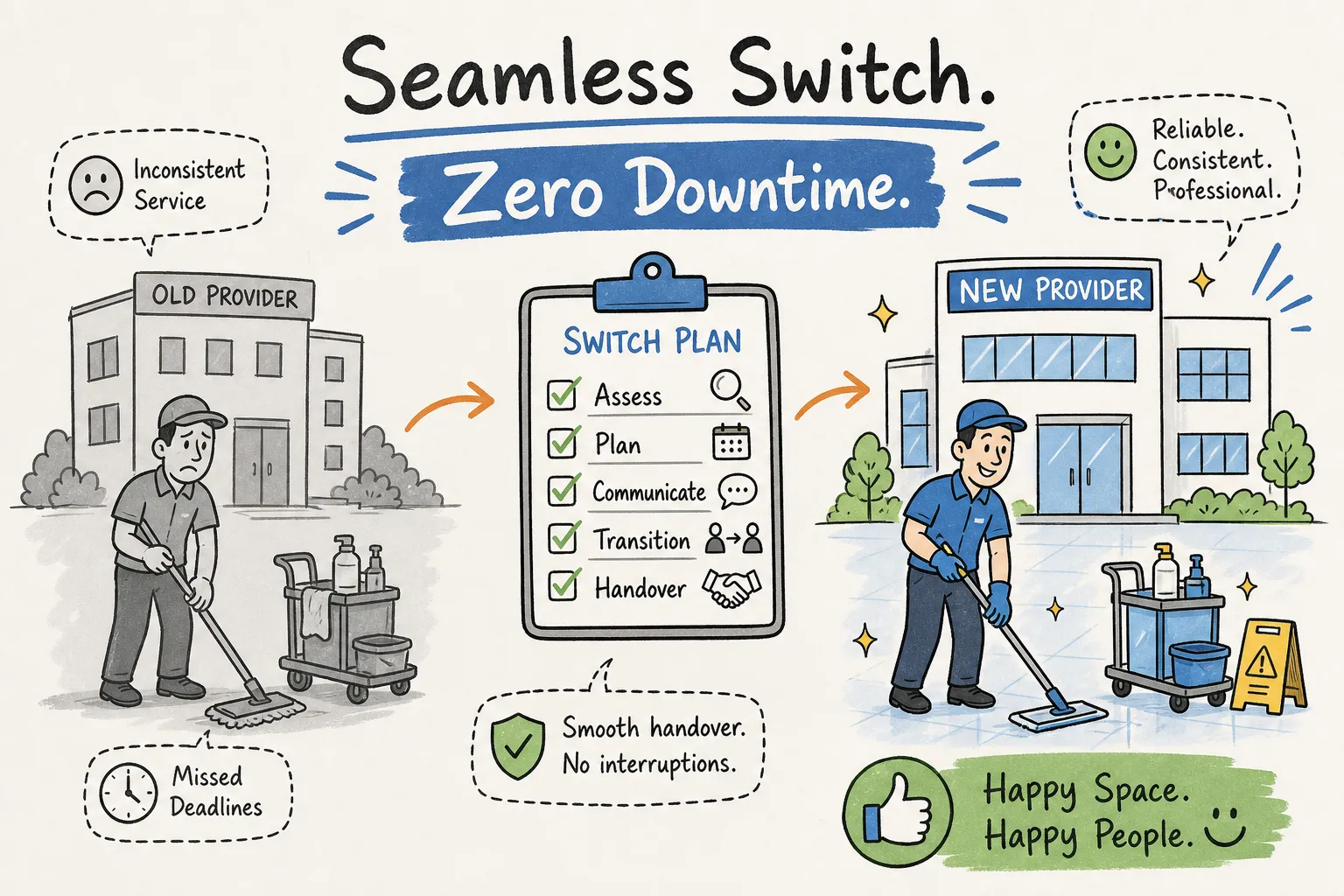
The restrooms haven't been right in months. The floors look dull no matter how many follow-up calls you make. Emails go unanswered for days, and when someone does respond, nothing changes at the next visit. Most facility managers recognize the problem. What keeps them stuck is the gap: what happens between the old company leaving and the new one starting? What if cleanings get missed? What if keys never come back?
A smooth changeover is completely manageable if you follow a clear sequence: recognize the pattern, read your contract, vet a replacement, give written notice, build in an overlap window, secure every key and code, onboard the new provider with a walk-through and written scope, and inspect weekly through the first month. At Sweepers, we work with businesses across Northeast Alabama that have finally decided to make the move, and the transition is almost always smoother than they expected. Most of the stress comes from not knowing which order to tackle things in. This guide lays out that order.
1. Recognize when patience has run out
The difference between a bad month and a bad contractor
Every cleaning company has an off week. Equipment breaks, someone calls out, something gets missed. What matters is the response. A contractor worth keeping communicates proactively, corrects the miss without being asked twice, and doesn't repeat the same problem at the next visit.
A real problem looks like a pattern: the same restroom skipped week after week, floors consistently under-cleaned, no supervisor response after three follow-ups. That's not a performance blip. It's a structural issue with the vendor's staffing, supervision, or commitment to your account.
What staying too long costs you
Facility managers often underestimate the soft costs of a poor cleaning contractor. Employee complaints pile up. Inconsistent sanitation creates real health risks. Client-facing spaces stop making the right impression. Every hour spent chasing a follow-up is an hour you're not running your operation, and once you add it up, the case for switching usually becomes obvious.
2. Read your current contract before you do anything else
Before you call a new vendor or send any notice, pull the signed agreement and read the termination section carefully. This single document controls your timeline. If you're not sure what a complete agreement should contain, our line-by-line breakdown of a janitorial service contract walks through each section.
Notice periods and auto-renewal clauses
Most commercial cleaning contracts require 30 to 60 days of written notice for termination. Smaller accounts tend to fall at the 30-day mark; larger or multi-site facilities often require 60 to 90 days. That notice period sets the date your outgoing vendor stops service, and that date anchors everything else in your transition.
The trap most people miss is the auto-renewal clause. Many contracts include a non-renewal window, often 60 to 90 days before the end of the term, and missing it can roll the agreement into another full year, sometimes at a higher rate. Check for both the notice period and the non-renewal deadline, along with any early termination fee and the exact delivery requirements for notice.
For-cause vs. for-convenience termination
Early termination charges typically apply when you exit before the initial term ends for convenience, not when you give proper notice at the right time. If you have documented, recurring service failures, you may have grounds to terminate for cause instead. Many contracts include a cure period of 5 to 15 business days that gives the vendor a chance to fix the problem; if it isn't resolved, a for-cause termination can shorten or eliminate the notice period.
Before invoking a for-cause clause, document every failure with dates, photos, and written follow-ups. That record protects you and gives the contractor a fair opportunity to respond before the termination letter goes out.
3. Find and vet your replacement before you give notice
The businesses that struggle with a switch are often the ones that give notice before they've picked a new vendor. Line up your replacement first, so the incoming provider is ready when the outgoing one leaves.
Criteria that go beyond price
The cheapest bid often hides gaps in scope or relies on subcontractors with limited direct oversight. You're buying a system, not a number on a page. A solid proposal spells out every task, frequency, method, and standard, not vague language like "general cleaning." Look for documented quality control, including inspection reports, restroom logs, and a clear complaint resolution process. Confirm current insurance, bonding, and references from comparable facility types before the conversation goes further.
Interview questions and reference checks
The most useful questions cut straight to accountability. Who is assigned to our account, and are they W-2 employees or subcontractors? What's your backup plan when someone calls out? How is quality documented between visits? Will you walk our facility before quoting?
Ask for at least two references from similar-sized facilities, and ask them specifically whether quality held up after the first three months, not just during onboarding. That's where the real picture emerges.
At Sweepers, we conduct an in-person site walkthrough before bidding on any new facility, train crews to ISSA/CIMS standards, follow up with regular quality checks, and back every clean with a written service scope and a make-good guarantee. No national chain call center, just a locally rooted team that knows your facility before the first night on the job.
4. Send written notice and lock in your key dates
Once your replacement is selected, send formal termination notice. This is not the place for a phone call or a casual email. Written notice creates a paper trail, and the delivery method matters.
What your termination notice needs to include
Send your notice in writing by certified mail or by email with delivery confirmation, addressed to the party named in the contract. State clearly that you're terminating the agreement, include the date of notice, reference the applicable contract clause, and specify the final service date based on your notice period. Keep a copy and request written confirmation that notice was received. That confirmation matters if there's ever a dispute about the termination date.
Use the notice period to set the new vendor's start date
With a confirmed final service date for your outgoing vendor, work backward. Set the cutover date in writing, roughly 30 days out, so everyone shares the same timeline. Rushing the sequence is how dates overlap awkwardly and either the outgoing vendor leaves early or the new one starts before they're set up.
5. Build an overlap window to prevent service gaps
A same-day vendor swap is one of the most common causes of missed cleans. The better approach is a short parallel period: the outgoing vendor keeps primary responsibility for their remaining scheduled cleanings while the new provider completes setup, receives access, walks the facility, and shadows the site. You're never in a position where nobody is responsible for the cleaning.
Why a 2 to 4 week parallel period works
During the overlap, the incoming crew learns the site in practice, not just from documents. They finalize the written scope, confirm access, and get familiar with the space before their first solo shift. For larger or more complex sites, some facility managers extend this window to 30 to 60 days.
A practical week-by-week timeline
- Week 1: Send notice to your outgoing vendor and schedule a walk-through with the new provider.
- Week 2: Receive the written scope from the new vendor and prepare access items.
- Week 3: New vendor completes a supervised or shadow visit of the facility.
- Week 4: Full handover; the outgoing vendor finishes their final shift.
Prepare a handover package
The incoming contractor needs more than a key and a start date. Prepare a complete handover package with site-specific procedures, supply locations, equipment instructions, restroom restocking standards, floor care schedules, emergency contacts, and any special handling requirements for sensitive areas like server rooms, medical spaces, or food prep zones. It keeps the new crew from spending their first two weeks relearning what the old crew figured out over two years.
6. Run a final walk-through with the outgoing contractor
The final walk-through should happen with the outgoing supervisor present, not after they leave. Walk every area against the agreed scope and check:
- Floors vacuumed, mopped, and edge-cleaned
- Restrooms detailed and dispensers fully stocked
- Kitchen and breakroom surfaces free of residue and odors
- Glass and mirrors streak-free
- High-touch points, light switches, door handles, and rails wiped down
- Dust cleared from vents, ledges, and baseboards
- All trash fully removed
Photograph every deficiency, note it by location, and assign it to the responsible party. Nothing gets signed off until it's resolved.
7. Collect access items and update your security
Security is where details tend to slip in a vendor transition. Treat the access handover as a controlled process with documentation at every step.
Inventory everything the outgoing vendor holds
Before the last shift, make a written list of every key, fob, badge, alarm code, garage credential, loading dock access, and restricted-area permission the outgoing vendor holds. Collect every item in person on the final service night and confirm each return in writing. For electronic access, deactivate credentials in your access control system on the last service date, not just by recovering the physical card.
Set up the new vendor's access the right way
Change alarm codes on the changeover date whether or not physical credentials came back. If any master key is unaccounted for, re-key the affected locks. Issue the incoming vendor only the access they need, and verify their personnel list against background checks before anyone enters the facility. Before the first solo shift, do a test run so the crew can enter, disarm the alarm, and follow your emergency procedures without issue.
Verify insurance before the first clean
Request a certificate of insurance from the incoming contractor before they step into the building. Verify active general liability coverage of at least $1 million per occurrence, workers' compensation, and any bonding your contract requires, and confirm additional-insured status where your contract calls for it. Without verified coverage, a day-one incident can leave you or the building owner facing unexpected liability.
8. Onboard your new provider with a walk-through and written scope
A walk-through isn't a courtesy. It's how a competent cleaning company builds an accurate scope, spots problem areas, and understands your scheduling and security constraints. A replacement that skips this step is guessing, and guessing leads to the same complaints you had with your last vendor.
Why an in-person walk-through before day one matters
A thorough provider will document the current condition of the space and flag high-traffic restrooms, entry mats, VCT floors that need maintenance, and any areas with specific standards. They'll confirm access procedures, note where supplies are stored, and learn your schedule. Walk the facility together again on day one, not just during the sales visit, and put any site-specific requirements in writing so there's no ambiguity when you're not there.
What a written service scope should spell out
The written scope should define every area covered and the frequency of each task (daily, weekly, and periodic). Not just "clean restrooms," but how often, which products, what restocking is included, and what a passing inspection looks like. It should also cover who supplies consumables, any excluded areas, and what happens when a cleaning falls short. If a new vendor can't hand you a written scope before day one, take that seriously before you hand over building access.
9. Run weekly quality checks through the first 30 days
The first month is when patterns get established. A problem caught in week one is a five-minute conversation. A problem ignored through week four becomes a standard the crew thinks is acceptable.
What a first-month inspection covers
Walk a few key areas each week with the same framework: restrooms (cleanliness, odor, supply levels), common areas (floors, glass, entryways), workspaces (high-touch surfaces, trash removal), and break rooms (counters, appliance exteriors, sinks). Give written feedback each time. You're looking for patterns, not isolated misses. If issues come up, keep the weekly cadence through month two; if performance is solid, move to bi-weekly and eventually monthly.
How to handle a missed or substandard cleaning
Many legitimate providers include a make-good clause: if a cleaning falls below standard, they return and fix it within a defined window. Confirm this is in your agreement before signing. If something comes up in week one, document it with photos and raise it directly with your account contact. Early feedback sets the tone for the whole relationship.
A contractor who welcomes written feedback is signaling confidence in their own quality system. One who gets defensive is telling you how they'll handle problems six months in.
The switch doesn't have to mean disruption
Switching commercial cleaning companies works when it's planned, not rushed. Read your contract, line up your replacement, give proper written notice, overlap the crews, document the handover, secure every key and code, verify insurance, and inspect closely through the first month. The facilities that make this transition smoothly treat it like a project with a checklist, not an emergency with a deadline.
If you're in Northeast Alabama and looking for a replacement contractor that won't require constant follow-up, Sweepers does in-person walkthroughs before every quote, operates on month-to-month agreements, and will walk you through exactly what the transition looks like before you sign anything. Get in touch with our team and we'll walk your space before we quote it.
Frequently asked questions
How much notice do I need to give my current cleaning company?+
Most commercial cleaning contracts require 30 to 60 days of written notice. Larger or multi-site accounts may require 60 to 90 days. Check the termination clause for the exact period, the delivery method it requires, and any auto-renewal deadline.
Should I hire the new cleaning company before I cancel the old one?+
Yes. Vet and select your replacement first, then send notice. That way the new provider can walk the facility, write a scope, and be ready to start the day after your outgoing vendor's final shift.
How long does it take to switch commercial cleaning companies?+
About three to four weeks for most facilities, including a short overlap period. Larger or more complex sites sometimes plan a 30 to 60 day transition.
Can I cancel a cleaning contract early for poor service?+
Often, yes. If you have documented recurring failures, many contracts allow termination for cause after a cure period of 5 to 15 business days. Keep dates, photos, and written follow-ups for every miss.
What should I collect from the outgoing cleaning company?+
Every key, fob, access card, badge, alarm code, and garage or dock credential they hold. Confirm each return in writing, deactivate electronic credentials on the final service date, and change alarm codes on changeover day.

What's actually included in a janitorial service contract?
A standard janitorial service contract includes five things. If a quote you've received is missing any of them, you're not comparing prices, you're comparing guesses.

6 questions to always ask a professional cleaning service
Not all commercial cleaning companies are built the same. Before you hand over keys to your facility, these six questions will tell you who you are really dealing with.

How to choose the best commercial cleaning company
The right cleaning partner protects your facility, your image and your peace of mind. Here is how to tell the dependable companies apart from the rest before you sign.