Commercial restroom cleaning standards: what "clean" should actually mean
Restrooms are the smallest rooms in your building and the source of most of its complaints. Here's the standard, spelled out fixture by fixture.
 Summarize with ChatGPT
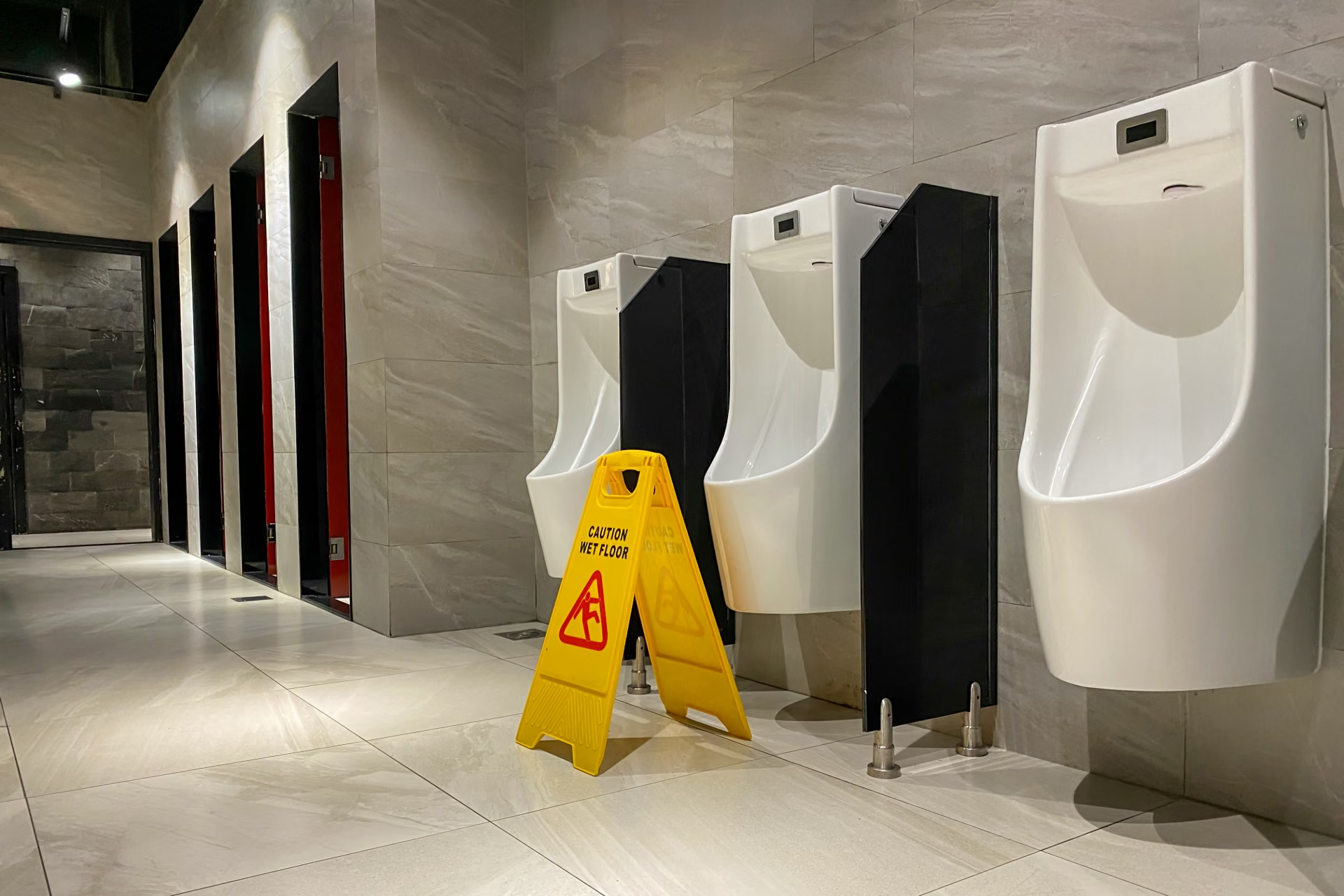
A properly cleaned commercial restroom meets a simple standard: every fixture disinfected, every dispenser full, floors clean into the corners, no odor at all, and nothing broken left unreported. Not "pretty good for a Tuesday." Every fixture, every visit. Restrooms are the smallest rooms in your building and the source of most of its complaints, and the gap between wiped-down and actually clean is where those complaints live.
Employees judge their employer by the restroom. Customers judge your whole business by it. So it's worth spelling out, in detail, what the standard should be, because "clean the restrooms" appears on every janitorial proposal ever written and means wildly different things depending on who wrote it.
Why do restrooms generate so many complaints?
Because everything in them is a touchpoint, a moisture source, or both. A restroom concentrates more germs, more odor potential, and more plumbing per square foot than anywhere else in a facility, and it gets visited by everyone in the building several times a day. A missed conference room shows dust in a week. A missed restroom announces itself by lunchtime.
There's also a compounding effect. Users treat a restroom the way they find it. A spotless restroom stays reasonably tidy between services; a rough one deteriorates fast, because nobody's careful in a room that looks like nobody cares.
What does the fixture-by-fixture standard look like?
Toilets and urinals get cleaned and disinfected completely: bowl and under the rim with a bowl cleaner, then seat, lid, exterior, base, and the flush handle, which is touched by every user and skipped by every rushed cleaner. The wall and partition beside urinals need attention too, for reasons everyone understands and nobody discusses.
Sinks and counters get cleaned and disinfected including faucet handles, with chrome dried and polished so it doesn't spot. The same disinfecting and sanitizing protocol covers every high-touch surface in the room. Mirrors cleaned streak-free, because a smeared mirror makes an otherwise clean restroom read dirty. Dispensers wiped down and, critically, refilled: soap, towels, tissue, seat covers if used. An empty dispenser is a failed service visit even if every surface gleams. Sweepers manages consumable stocking as part of service so it's never your staff's emergency.
Floors get swept, then wet-mopped with disinfectant into the corners, behind the toilet, and along the baseboard, which is where honest cleaning is distinguished from a quick figure-eight down the middle. Grout lines in tile floors need periodic machine scrubbing; darkened grout is absorbed soil, and it holds odor.
Touchpoints round it out: door handles and push plates both sides, light switches, stall latches, grab bars. These are disinfection priorities, not afterthoughts.
How should a crew handle restroom odor?
Rule one: a clean restroom smells like nothing. Fragrance masking an odor is a confession, not a solution.
Persistent restroom odor almost always has a physical source, and a good crew hunts it rather than spraying over it. The usual suspects, in order: urine soaked into grout or the caulk line at the base of fixtures, which needs scrubbing and sometimes recaulking rather than mopping; dried-out floor drain traps, which let sewer gas rise and are fixed by regularly flushing the drain; overlooked sanitary receptacles; and mop water itself, when a dirty mop just redistributes the problem. Restroom mops and cloths should be dedicated to restrooms and color-coded so they never migrate to the break room. That's a hygiene standard worth asking any prospective cleaning company about, alongside the basics in our post on questions to ask a professional cleaning service.
What's the difference between cleaning and disinfecting a restroom?
Cleaning removes visible soil with detergent and friction. Disinfecting kills pathogens with an EPA-registered product, and it only works on an already-clean surface with the product left wet for its full dwell time, often several minutes. A spray-and-immediate-wipe pass looks identical to the real thing and accomplishes a fraction of it. Crews trained on dwell times are doing sanitation; crews racing a stopwatch are doing theater. In a restroom, that difference is the entire point. Our facility sanitizing service is built around getting this right.
How often do restrooms need service?
Any restroom used daily needs cleaning daily, full stop. High-traffic restrooms, in retail, clinics, or plants, often need midday porter checks on top of nightly service just to keep dispensers stocked and floors dry. Then, on a monthly or quarterly cycle, the deeper work: machine-scrubbing floors and grout, descaling fixtures where hard water builds up, washing partitions and walls, and cleaning vents, which collect dust that undermines everything else. Every one of these frequencies belongs in a written scope, the same way we lay out a full building's needs in our office cleaning checklist. It's the standard we hold for every office and commercial facility on our route.
If your restrooms wouldn't pass the standard on this page, your cleaning scope needs rewriting. Sweepers services offices, clinics, retail stores, and industrial facilities across Northeast Alabama, and we're proud to be a member of the Chamber of Gadsden / Etowah County, where our crews are based.
Frequently asked questions
Our restrooms are cleaned nightly but still smell. Why?+
Look past the surfaces. Grout, fixture caulk lines, and dry drain traps are the usual culprits, and all three need more than a mop. We diagnose this constantly for new clients.
Should restroom supplies be included in a cleaning contract?+
It's the simplest arrangement. The crew that's in the restroom every night is the right party to track and restock consumables. Ours does.
What should employees do between cleanings?+
Report problems fast. A leak, a clogged fixture, or an empty dispenser reported at 10 a.m. is a footnote; discovered at 4 p.m., it's everyone's day.
Do you handle restrooms in industrial facilities?+
Yes, and they're often the hardest-working restrooms in Northeast Alabama. Plant restrooms need heavier service frequencies, and we scope them that way.
The complete office cleaning checklist: daily, weekly, and monthly tasks
If you have a cleaning service, audit them against it. If your staff cleans in-house, this is what "clean" actually requires, and it's usually more than anyone budgeted for.

Flu and cold season prep for Northeast Alabama workplaces: a facility disinfection game plan
Cleaning can't stop flu season, but a disciplined disinfection program takes the building itself out of the transmission chain.
What's actually included in a janitorial service contract? A line-by-line breakdown
A standard janitorial service contract includes five things. If a quote you've received is missing any of them, you're not comparing prices, you're comparing guesses.